


Table of Contents
- Does Stainless Steel Jewelry Tarnish?
- What You'll Need to Polish Tarnished Stainless Steel
- Step-by-Step: How to Polish Tarnished Stainless Steel Jewelry
- Best Jewelry Polishing Cloth for Stainless Steel
- How to Remove Scratches from Stainless Steel Jewelry
- Troubleshooting: Perfume Stains, Residue, and Ultrasonic Cleaner Safety
- Preventing Future Tarnish and Keeping the Shine
- Frequently Asked Questions
Last Updated: September 16, 2026
Does Stainless Steel Jewelry Tarnish?
Yes, stainless steel jewelry can tarnish, though far more slowly than sterling silver or brass. Stainless steel resists corrosion because chromium in the alloy forms a thin oxide layer, but that layer breaks down over time. Stainless steel jewelry can lose its shine after a year or two of daily wear.
The good news: surface tarnish on stainless steel is almost always reversible with household items. Below, we'll walk through the best way to polish tarnished stainless steel jewelry, including two proven cleaning methods, the right cloth to use, and how to prevent the problem from coming back.
ASM International materials reference on stainless steel corrosion
Why Tarnish Happens Even on Stainless Steel
Stainless steel isn't stain-proof, it's stain-resistant. The chromium oxide layer that protects the metal can be stripped by sweat, lotions, chlorine, and even humid air. Once that layer thins, oxygen reacts with the iron in the alloy, and you get that dull, discolored film.
What You'll Need to Polish Tarnished Stainless Steel
The best way to polish tarnished stainless steel jewelry starts with the right supplies, not the harshest ones. You need a mild abrasive, a non-scratching cloth, and a soft brush for crevices. Below is what actually works, what each item does at the material level, and what to skip.
| Supply | What it does | What to look for | Approx. cost |
|---|---|---|---|
| Mild dish soap | Lifts skin oils and lotion residue without stripping the chromium oxide layer | Unscented, dye-free, no "antibacterial" or citrus additives | Under $5 |
| Baking soda | Mild abrasive (Mohs ~2.5) that lifts tarnish film without cutting the steel | Plain sodium bicarbonate, not baking powder | Under $3 |
| Warm water | Carries away loosened residue and keeps soap active | Lukewarm, not hot | Free |
| Microfiber cloth | Buffs without leaving lint or micro-scratches | 300+ GSM, no fabric softener ever | $5-$10 for a pack |
| Soft-bristled toothbrush | Reaches chain links, clasps, and stone settings | Soft or extra-soft bristles only | Under $3 |
| Treated polishing cloth | Restores luster with a mild embedded polishing agent | Two-cloth system: one treated, one clean | $8-$15 |
Why grit matters more than brand
Stainless steel sits around 5.5-6.5 on the Mohs hardness scale depending on grade. Anything harder than that, steel wool (Mohs ~5.5 but abrasive in aggregate), scouring pads, or powdered cleansers like Comet, will scratch the surface and, on plated pieces, cut straight through the plating. Baking soda at Mohs ~2.5 is soft enough to polish without cutting. That single number is the reason it shows up in nearly every safe method.
The cloth decision most guides skip
A plain microfiber cloth removes residue. A treated polishing cloth does something different: it deposits a mild abrasive and a anti-tarnish agent that fills the microscopic valleys left by wear, which is what actually produces the "just polished" look. If your piece is dull rather than discolored, the treated cloth is doing the work, not the soap. Keep the treated cloth in its pouch; once it turns black it is spent and will start redepositing residue.
Skip abrasive cleaners, steel wool, and anything labeled "heavy-duty." They scratch the surface and remove plating on mixed-metal pieces. Also skip toothpaste, the silica and fluoride additives are formulated for enamel, not metal, and leave a haze that is harder to remove than the tarnish you started with.
Step-by-Step: How to Polish Tarnished Stainless Steel Jewelry
Total time: 10-15 minutes. Difficulty: Beginner.
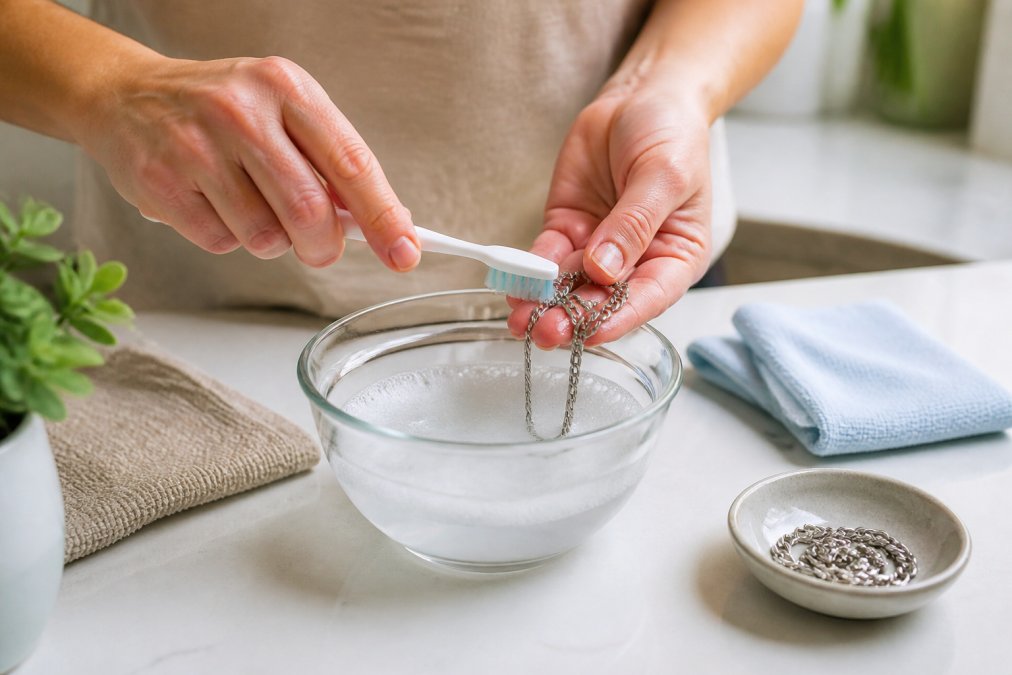
Method 1: Mild Dish Soap and Warm Water
- Fill a bowl with warm water and a few drops of mild dish soap.
- Soak the jewelry for 5 minutes to loosen surface oils.
- Scrub gently with a soft-bristled toothbrush, focusing on links and edges.
- Rinse under warm running water until no soap remains.
- Pat dry immediately with a microfiber cloth.
This method handles everyday buildup, not deep tarnish.
Method 2: Baking Soda and Water Paste
- Mix two parts baking soda with one part water to form a paste.
- Apply with a soft cloth, rubbing in one direction.
- Work the paste into tarnished areas for 30 seconds per section.
- Rinse thoroughly under warm water.
- Buff dry with a clean microfiber cloth.
How to Dry Stainless Steel Jewelry
Drying matters as much as cleaning. Water left in crevices causes new spots and accelerates oxidation. Pat the piece dry with a microfiber cloth, then let it air-dry for 10 minutes before storing. Never use a hair dryer, since heat can warp thin settings.
Best Jewelry Polishing Cloth for Stainless Steel
A microfiber cloth is the safest choice for stainless steel because it lifts residue without scratching. For restoring shine, a treated polishing cloth like the Connoisseur's Jewelry Polishing Cloth adds a mild polishing agent that buffs out light dullness.
Avoid paper towels and rough fabrics. They leave lint and micro-scratches that dull the surface over time.
How to Remove Scratches from Stainless Steel Jewelry
Light surface scratches respond to polishing; deep gouges usually don't. For minor scratches, rub a baking soda paste across the grain with a microfiber cloth for 60 seconds, then buff. For deeper scratches, a jeweler's rouge and a buffing wheel are the only reliable fix. Know when to stop: aggressive polishing removes metal and thins the piece.
Troubleshooting: Perfume Stains, Residue, and Ultrasonic Cleaner Safety
Most guides stop at soap and water. The problems that actually send people searching, a cloudy film that won't rinse off, a cleaner that might ruin a plated piece, a scratch that won't buff out, need their own answers.
Perfume, lotion, and sunscreen residue
Beauty products leave a film that is chemically different from tarnish.
What works, in order:
- Dawn-style grease-cutting dish soap (a few drops in warm water), the surfactants are formulated to break lipid films, which is why it outperforms hand soap here.
- Soak 5 minutes, then agitate with a soft toothbrush. Do not scrub dry; you will drag the residue into crevices.
- Rinse and repeat once if the film persists. Two passes handle most sunscreen buildup.
- For stubborn residue, make a paste of baking soda and a few drops of dish soap (not just water), the soap keeps the abrasive suspended and the paste lifts the film instead of pushing it.
Ultrasonic cleaner safety
- Plated stainless steel, the cavitation bubbles can lift plating at the edges, especially on older or worn pieces.
- Glued or friction-set stones, vibration loosens adhesive and can shake a stone free.
- Pieces with enamel, resin, or inlay, these materials can crack or cloud.
- Antique or repaired pieces, solder joints can fail.
When a scratch is a cleaning problem vs. a polishing problem
This is the distinction most guides miss.
Preventing Future Tarnish and Keeping the Shine
Frequently Asked Questions
Can you use vinegar to clean stainless steel jewelry?
Yes, distilled white vinegar diluted with warm water can remove light water spots and surface dullness from stainless steel. Mix one part vinegar with three parts water, soak the jewelry for 5-10 minutes, then rinse thoroughly and pat dry with a microfiber cloth. Vinegar has a strong odor and is acidic, so use it sparingly. Avoid overuse, as repeated exposure can affect plated finishes over time. For heavy tarnish, baking soda paste or a dedicated polishing cloth works better.
Is it safe to use baking soda on stainless steel?
Baking soda is safe when mixed with water into a smooth paste and applied gently with a soft cloth or soft-bristled toothbrush. It acts as a mild abrasive that lifts tarnish without scratching the surface. Avoid using dry baking soda or scrubbing too hard, which can create micro-scratches. Rinse completely after use to prevent residue from dulling the finish. For best results, follow with a microfiber cloth buffing to restore luster.
Does stainless steel jewelry tarnish, and how do I prevent it?
Stainless steel jewelry can tarnish over time due to oxidation, skin oils, lotions, and humidity, though it resists tarnish better than sterling silver. To prevent future tarnish, wipe your jewelry with a soft microfiber cloth after each wear, store pieces in a dry pouch or airtight container, and keep them away from perfume and lotions. Routine cleaning with mild dish soap and warm water removes buildup before it causes dullness, keeping your stainless steel looking polished.
How do I remove scratches from stainless steel jewelry?
Light scratches on stainless steel jewelry can be buffed out using a jewelry polishing cloth with micro-abrasives or a baking soda paste applied in circular motions. For deeper scratches, a professional jeweler can refinish the surface. Always work gently and avoid abrasive cleaners that contain harsh chemicals, which can worsen the damage. After buffing, rinse and dry the piece thoroughly. Preventing scratches starts with storing jewelry separately and removing it during rough activities.
Tarnish on stainless steel is a maintenance problem, not a durability problem. When you want jewelry built to hold its finish through daily wear, Flogaze offers high-quality stainless steel construction, water-resistant and scratch-proof watch designs, and gift box packaging ready for immediate giving. Every piece is made to become a lasting keepsake. Get started with Flogaze and give a gift that stays bright for years.


