


Table of Contents
- What Handwriting Engraving on Jewelry Actually Is
- Why a Handwritten Script Beats a Standard Font
- How to Prepare Handwriting for Engraving
- Handwriting Jewelry Durability: What Survives Daily Wear
- Choosing a Custom Handwriting Necklace or Ring
- Where Handwriting Engraving Falls Short
- Frequently Asked Questions
Last Updated: September 16, 2026
What Handwriting Engraving on Jewelry Actually Is
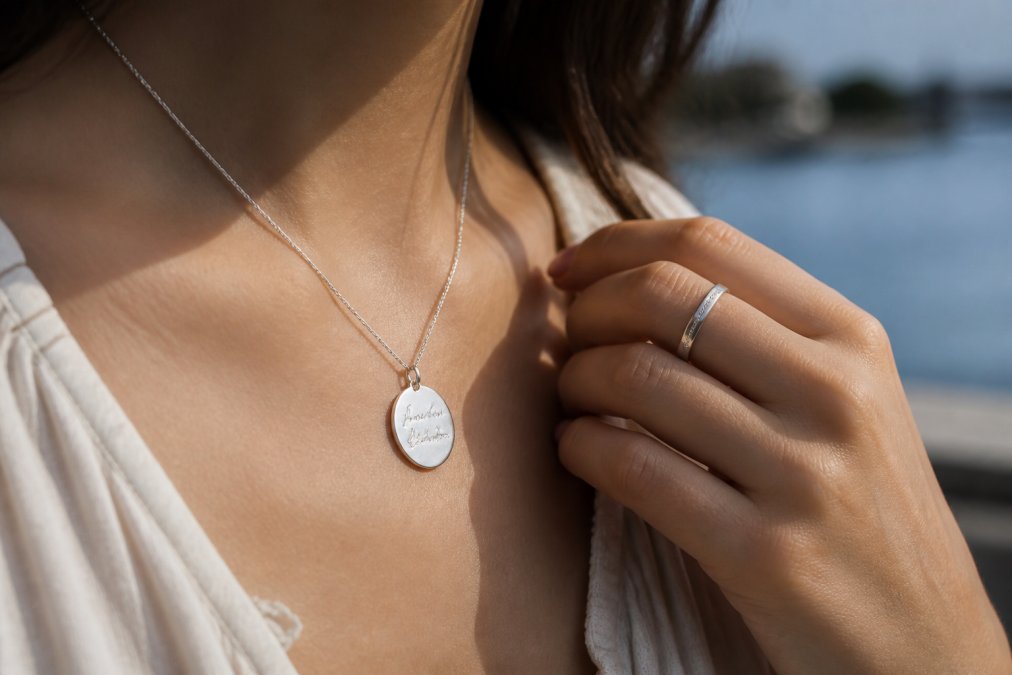
Handwriting engraving on jewelry is the process of transferring a person's actual handwritten words or signature onto a metal surface, preserving the unique slope, pressure, and imperfections of their penmanship as a permanent keepsake.
The short answer to whether handwriting engraving on jewelry is worth it: yes, for sentimental keepsakes you intend to wear or pass down. The technology behind it has matured. Modern laser engraving captures fine pen strokes with enough precision that a handwritten script reads as handwriting, not as a font pretending to be one. That distinction matters more than most buyers realize before they order.
Why a Handwritten Script Beats a Standard Font
A font is generic by design. Anyone can select "script" from a dropdown menu, which is exactly why a typed engraving rarely carries emotional weight. A handwritten script is unrepeatable: the way someone crosses a "t" or loops an "l" exists nowhere else.
The Emotional Difference a Real Signature Makes
Think about the last card you kept. You probably didn't keep it for the message. You kept it because of the handwriting. That instinct is what makes handwriting engraving worth considering for a memorial gift, an anniversary gift, or a graduation keepsake. A custom message in a relative's own hand turns a piece of personalized jewelry into a sentimental keepsake rather than a product.
How to Prepare Handwriting for Engraving
Preparation determines the final result more than any other step, and it is where most disappointing orders go wrong. You need a clean, high-contrast source image, ideally a high-resolution scan rather than a phone photo. But the file is only half the story. The other half is whether the handwriting itself can survive being shrunk onto metal, and that is where most guides stop short.
Here is the practical sequence:
- Find the clearest sample of the handwriting you have. A signed card beats a grocery list.
- Scan it at 600 dpi or higher on a flatbed scanner if possible.
- If you only have a photo, shoot it straight-on in indirect daylight with no shadow across the ink.
- Crop tightly around the words you want engraved, leaving a small margin.
- Send the original file, not a screenshot or a photo of a screen.
The Technical Limits Nobody Tells You About
Resolution is the first constraint. A scan at 600 dpi captures roughly 600 dots per inch of the original paper, which is more than enough to trace a pen stroke. A phone photo of the same card may capture far less detail once you crop in, and cropping is where resolution disappears. If the words you want occupy a small part of a large photo, the effective resolution on those words may be too low to trace cleanly.
Stroke thickness is the second constraint. A laser or diamond-drag tool has a minimum line width it can cut, often measured in fractions of a millimeter. If the original handwriting has very thin strokes, the engraver has to either thicken them slightly (which changes the look) or risk a broken, faint line. Bold, medium-weight handwriting reproduces more faithfully than hairline cursive.
Material compatibility is the third. The same handwriting file can look crisp on stainless steel and muddy on a soft, highly reflective metal, because reflectivity and surface finish affect how the mark reads. A matte or brushed finish tends to show engraving more clearly than a mirror polish.
Sample Quality Checklist
- Ink is dark and unbroken, with no fading or smudging
- Background is plain and light-colored
- The full phrase is visible, including any loops that extend below the baseline
- Image is sharp when zoomed in, not blurry or pixelated
- No glare, shadow, or finger covering part of the text
Troubleshooting a Faded or Damaged Sample
Old letters, faint pencil, and signatures that fade at the end are common, and they are not automatically disqualifying. What they cannot do is invent detail that was never captured, so the more of the original you can supply, the better the result.
A few practical moves help. Photograph the sample under raking light, which is light angled from the side rather than straight on, because it casts tiny shadows that make faint indentations visible. If you have multiple samples of the same person's handwriting, send them all; the engraver can pull the clearest version of each letter from different sources. If the handwriting is on a curved or textured surface, flatten it as much as possible before scanning. And if the sample is torn or stained, send a photo of the whole document anyway, because context can help the engraver reconstruct a partial word.
Handwriting Jewelry Durability: What Survives Daily Wear
Durability comes down to two variables: the metal and the engraving method. A shallow mark on a soft metal will blur within a year of daily wear. A properly cut engraving on stainless steel or sterling silver holds its detail for years. Before you compare metals, it helps to know which method produced the mark, because the method sets the depth.
The Three Engraving Methods and What They Mean for Wear
Laser engraving uses a focused beam to vaporize or fuse the metal surface. On stainless steel and titanium, the mark is essentially part of the metal, which is why it survives water, sweat, and scratching. On plated or coated pieces, the laser can cut through the plating and expose the base metal underneath, so a laser mark on gold vermeil may look crisp at first and then reveal a different color as the plating wears.
Diamond-drag engraving uses a diamond-tipped stylus to scratch a fine line into the surface. It produces the delicate, thin script many people associate with traditional jewelry engraving, and it works beautifully on gold, sterling silver, and platinum. The trade-off is depth: diamond-drag cuts are shallow by nature, so on a ring or bracelet that flexes and rubs, fine lines can soften over years of daily wear.
How Each Metal Behaves Over Time
Stainless steel resists water, sweat, and scratching, which is why it suits pieces meant for constant use.
Care and Maintenance for Engraved Pieces
Keep engraved jewelry away from chlorine and household cleaners. Rinse with warm water and mild soap, dry with a soft cloth, and store pieces separately so they don't rub against harder jewelry. For sterling silver, a polishing cloth restores shine without eroding the engraving. Skip ultrasonic cleaners on antique or deeply engraved pieces, since vibration can dull fine detail.
Choosing a Custom Handwriting Necklace or Ring
The right format depends on how much handwriting you want to show and how often the piece will be worn. A custom handwriting necklace works best for a short phrase or signature, because a pendant has limited surface area. Rings suit single words or initials. Bracelets and charms handle longer text but flex constantly, so engraving depth matters more.
| Piece | Best For | Surface Area | Wear Consideration |
|---|---|---|---|
| Necklace pendant | Signatures, short phrases | Small | Sits against skin, low friction |
| Ring | Single words, initials | Very small | High friction, choose deep cut |
| Bracelet or charm | Longer messages | Medium | Flexes, needs durable metal |
| Watch case back | Dates, short dedications | Medium | Protected from most contact |
Where Handwriting Engraving Falls Short
Honesty matters here, because engraving has real limits. Very small handwriting cannot be reproduced legibly, since the laser needs physical space to cut each stroke. Light pencil, faded ink, and low-resolution photos lose detail that no amount of editing restores. Curves and connected cursive are harder to render cleanly than block letters.
Frequently Asked Questions
Is handwriting engraving durable for everyday wear?
It depends on the metal and engraving method. Laser engraving on stainless steel typically holds up for years with normal wear. Pieces worn daily against skin and clothing will show gradual softening of fine lines over time, but a well-engraved handwritten script on a quality metal stays legible. Remove jewelry before swimming in chlorinated pools or using abrasive cleaners to protect the engraving depth.
Can I engrave my handwriting on jewelry?
Yes. You provide a clear photo or scan of the handwritten message, and the engraver converts it into a vector graphic for precise reproduction on the metal. A high-resolution scan or well-lit photo gives the cleanest digital file conversion and the most accurate final engraving.
How much does custom handwriting engraving typically cost?
Pricing depends on the metal, the size of the piece, the complexity of the handwriting, and the engraving method. A simple engraved charm costs less than a fully custom handwriting necklace in gold vermeil. Because pricing varies by design and material, check Flogaze's website for current rates on specific pieces rather than comparing generic estimates that may not reflect the actual work involved.
What should I avoid engraving on a ring?
Skip long messages on narrow bands because the curvature compresses the handwriting and reduces legibility. Avoid very thin script with fine cross-strokes that may fill in during engraving. Names, dates, and short phrases up to about ten words work best on rings. For longer messages, an engraved pendant or charm gives the handwriting more surface area and preserves the detail of the original script.
A handwritten engraving only pays off when the sample is clean and the metal can take the wear. Flogaze builds personalized jewelry around exactly that balance, with high-quality stainless steel construction, water-resistant and scratch-proof watch designs, and a gift box included so the piece arrives ready to present. Shop Now and turn a signature into a keepsake that lasts.


