


Table of Contents
- Why Personalized Stainless Steel Needs Special Care
- Does Stainless Steel Jewelry Tarnish? What to Expect
- How to Clean Stainless Steel Jewelry: Step-by-Step
- Cleaning Laser Engraved Stainless Steel Without Damage
- How to Store Personalized Accessories to Prevent Scratches
- Daily Habits That Ruin Engraved Jewelry
- Caring for Mixed-Material and Eco-Friendly Alternatives
- Conclusion: Keep Your Keepsake Bright for Years
- Frequently Asked Questions
Last Updated: September 9, 2026
Why Personalized Stainless Steel Needs Special Care
Learning how to care for personalized stainless steel accessories is essential because they carry meaning that mass-produced pieces simply don't. That engraved name, date, or short message transforms a functional item into a keepsake, which means the stakes for proper care are higher. Understanding how to care for personalized stainless steel accessories starts with recognizing that the engraving creates tiny grooves where dirt, oils, and lotion collect over time.
Stainless steel is corrosion-resistant and designed for daily wear, which is why brands like Flogaze build their personalized jewelry and watches around it. But the personalization layer changes the equation. A standard polish that works on a smooth surface won't reach inside deep laser engraving, and the wrong cleaning method can dull the very detail you wanted to preserve.
Caring for these pieces isn't difficult; it just requires a different approach than you'd use for a plain metal band. Below is the exact routine that keeps engraved surfaces crisp and bright for years.
Does Stainless Steel Jewelry Tarnish? What to Expect
Genuine stainless steel does not tarnish the way silver or copper does. Surgical steel, particularly 316L, is highly tarnish-resistant because its chromium content forms a protective layer that resists oxidation (the NIH). What you're likely seeing on a dull piece isn't tarnish, it's a buildup of skin oils, lotion, soap residue, and environmental grime.
That distinction matters. If you treat surface residue like tarnish and reach for a harsh polish, you risk scratching the metal and wearing down your engraving. Expect that your piece will need regular cleaning to remove everyday buildup, not aggressive restoration.
The one exception appears with prolonged exposure to harsh chemicals. Chlorine, bleach, and saltwater can break down that protective chromium layer over time, leading to surface discoloration that looks like tarnish. Jewelry care guidance from the American Gem Society emphasizes avoiding these substances with any fine jewelry, and stainless steel is no exception despite its durability.
How to Clean Stainless Steel Jewelry: Step-by-Step
Cleaning your personalized piece properly takes about five minutes and requires only supplies you likely already own. The routine below works for necklaces, bracelets, rings, and watches with stainless steel bands.
The Everyday Cleaning Method
Start with a small bowl of warm water and a few drops of mild dishwashing liquid. Drop your accessory in and let it soak for one to two minutes. This loosens the oils and residue that have bonded to the surface.
After soaking, use a soft-bristled toothbrush to gently work the soapy water across the piece. Pay special attention to the engraved areas, using light circular motions to lift debris from the grooves. A common mistake is scrubbing hard here, but the goal is to dissolve buildup, not scrape it off.
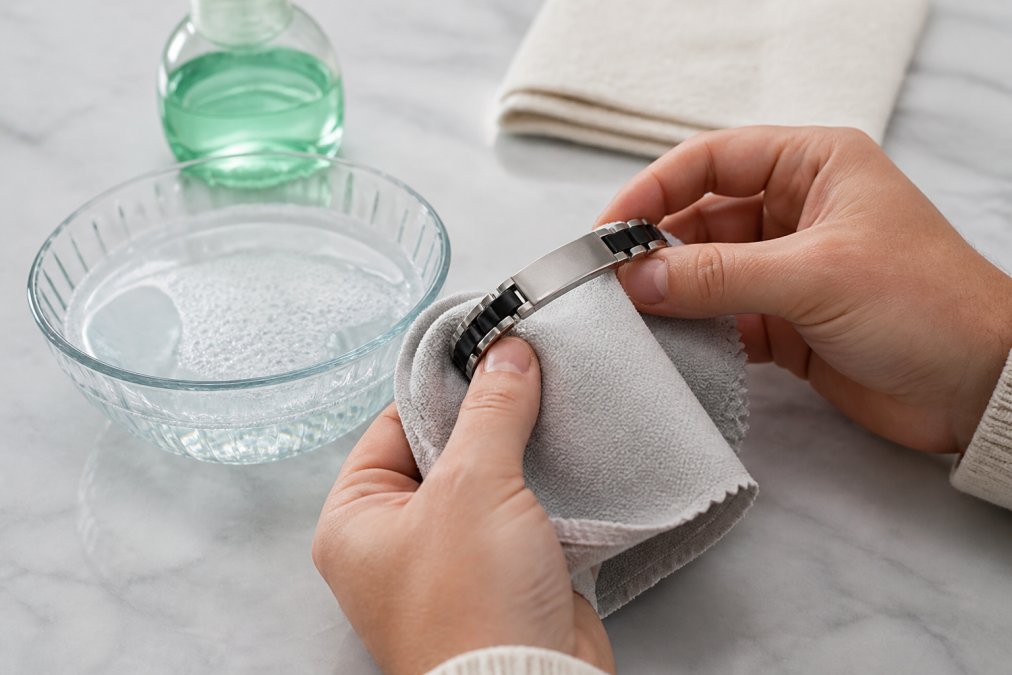
Rinse the piece thoroughly under running warm water to remove all soap residue. Leftover soap can actually dull the finish once it dries. Finally, pat dry with a soft, lint-free cloth and allow it to air dry completely before wearing or storing.
Removing Stubborn Stains and Oxidation
For buildup that a simple wash won't remove, create a paste from three parts baking soda and one part water. Apply it with your fingertips or a soft cloth, working gently over the stained area. Rinse thoroughly and dry.
For oxidation spots caused by chemical exposure, a vinegar solution can help. Mix one part white vinegar with three parts water, soak the piece for no more than five minutes, then rinse and dry immediately. Never let stainless steel sit in vinegar for extended periods, as the acid can eventually pit the surface.
Cleaning Laser Engraved Stainless Steel Without Damage
Most care guides treat engraving as a single, uniform feature. In practice, the personalization on your accessory falls into two distinct categories, and each requires a different cleaning approach. Understanding which one you own is the first step to protecting it.
Surface Etching (Fiber Laser): This process creates a shallow, smooth mark by heating the metal to produce a dark oxide layer. The result is a high-contrast design that sits nearly flush with the surface. Because the texture change is minimal, these pieces are the easiest to care for. You can use the standard warm water and mild dish soap method without special precautions, as there are no deep grooves for debris to hide in.
Deep Engraving (CNC or Rotary): This method physically cuts a groove into the metal, creating a recessed design with a distinct texture. This is common on items like dog tags, bracelets, and flasks where a tactile, permanent mark is desired. The recessed areas are more vulnerable; they collect skin oils, lotion, and grime more readily, and they are susceptible to damage from abrasive tools that can smooth away the sharp edges of the lettering.
The Deep-Clean Protocol for Engraved Grooves
For deeply engraved pieces, a simple soak is often not enough. The surface tension of water can trap air in the grooves, preventing the soapy solution from reaching the debris. To overcome this, you need to actively work the solution into the recesses.
- Prepare a warm, soapy bath using a few drops of a mild, phosphate-free dish soap. Avoid any soap with moisturizers or dyes, as these can leave a residue.
- Submerge the piece and use a soft-bristled toothbrush (a baby toothbrush is ideal) to gently agitate the surface. Focus on the engraved areas, using small, circular motions to break the surface tension and force the soapy water into the grooves.
- Use a soft wooden toothpick for stubborn debris lodged in tight corners of letters or intricate designs. The wood is softer than the steel and will not scratch the surface, but it is rigid enough to dislodge compacted grime. Never use a metal pick or pin.
- Rinse thoroughly under a strong stream of lukewarm water. The pressure of the water helps flush out the dissolved oils and soap from the grooves.
- Dry with a two-step process. First, pat the entire piece dry with a lint-free cloth. Then, take a fresh, dry cotton swab and carefully wick out any remaining moisture from inside the engraved lines. Allowing water to air-dry inside the grooves can lead to mineral deposits that dull the contrast of the engraving.
The Long-Term Impact of Engraving on Structural Integrity
A common question is whether engraving weakens the metal. A shallow surface etch has virtually no impact on the structural integrity of a thick stainless steel pendant or watch case. However, a deep CNC engraving removes a small amount of material. On a very thin item, such as a slim ring band or a lightweight ID tag, a deep engraving can create a stress point. This is not a reason to avoid cleaning, but it is a reason to avoid any activity that could bend or torque the metal. If you have a deeply engraved ring, remove it before heavy lifting. The metal is more likely to bend at that point, and a bent ring with an engraving is far more difficult to repair than a plain one.
How to Store Personalized Accessories to Prevent Scratches
Proper storage prevents most damage before it starts. Stainless steel is scratch-resistant, not scratch-proof. When pieces rub against each other or against harder materials, they can develop fine surface marks that dull the finish.
Store each engraved piece separately. A soft jewelry pouch or a compartmentalized jewelry box keeps items from contacting one another. If you don't have individual pouches, wrap each piece in a soft cloth before placing it in a shared container.
Keep storage away from humidity and direct sunlight. A cool, dry drawer works well. Avoid storing stainless steel in bathrooms where moisture and temperature fluctuations accelerate surface reactions. Storage and care tips from the Gemological Institute of America recommend a dry, dark environment for all jewelry to preserve both metal and any accompanying materials.
Daily Habits That Ruin Engraved Jewelry
The biggest threats to your personalized piece aren't cleaning mistakes, they're daily habits that expose the metal to unnecessary wear. Most people don't realize how often their accessories contact substances that degrade the surface.
Remove your stainless steel accessories before swimming. Chlorine in pools and salt in ocean water are two of the most aggressive substances for metal jewelry. Even tarnish-resistant surgical steel will eventually show damage from repeated exposure.
Apply perfume, hairspray, and lotion before putting on your jewelry, not after. These products contain alcohols and chemicals that can cloud the surface finish and build up inside engraving. Wait a few minutes for products to dry before accessorizing.
Caring for Mixed-Material and Eco-Friendly Alternatives
Personalized accessories rarely exist in isolation. A stainless steel pendant often hangs on a leather cord, a bracelet might feature wooden beads, or a ring could have a stone inlay. Cleaning these hybrid pieces requires a segmented approach: treat the metal and the non-metal components separately to avoid damaging one while cleaning the other.
The Segmented Cleaning Method
Step 1: Isolate the Metal. Before any cleaning, identify all the materials on the piece. If the accessory has a leather strap, a fabric cord, or a porous stone like turquoise or opal, do not submerge the entire item in water. Instead, dip a soft cloth in your warm, soapy water and wring it out until it is just damp. Use this to wipe down only the stainless steel components, being careful to avoid the other materials.
Step 2: Address the Non-Metal Materials.
- Leather: Clean leather with a dedicated leather conditioner or saddle soap. Apply a small amount to a soft cloth and rub it in gently. This replaces oils lost through wear and prevents cracking. Never use alcohol or harsh soaps on leather, as they will dry it out.
- Wood: Wipe wooden beads or inlays with a dry, soft cloth. If they are particularly dirty, use a cloth that is barely dampened with water. Dry immediately. Wood should never be soaked, as it can swell and crack.
- Stones: For hard stones like cubic zirconia or sapphire, you can use a soft toothbrush with the soapy water. For porous stones like turquoise, pearl, or opal, avoid water entirely. Wipe them with a dry, soft cloth only, as water can discolor them.
Step 3: Dry and Reassemble. Ensure all components are completely dry before storing the piece. Pay special attention to the connection points where the metal meets the leather or cord, as moisture can get trapped there and weaken the adhesive or knot over time.
Restoring Oxidized or Discolored Personalized Steel
Even with the best care, a piece can develop discoloration. This is rarely true rust, but rather a surface reaction from exposure to chlorine, hard water, or acidic body chemistry. This is a repair task, not a routine cleaning task, and it requires a more deliberate approach.
The Baking Soda Poultice Method: For stubborn oxidation spots, create a thick paste of three parts baking soda to one part water. Instead of just rubbing it on, apply a generous layer directly to the discolored area. Let it sit for 10-15 minutes. The paste will gently draw out the oxidation from the surface. After it has dried slightly, use a soft, damp cloth to buff the paste off in a circular motion. Rinse thoroughly and dry. This method is less abrasive than scrubbing and is safer for preserving the edges of an engraving.
The Vinegar Flash Treatment: For more significant discoloration, a diluted white vinegar solution (one part vinegar to three parts water) can be effective. The key is time control. Soak the piece for no more than two minutes. The mild acid will break down the oxidation. Immediately after soaking, rinse the piece under warm running water and then neutralize any remaining acid by dipping it in a solution of one teaspoon of baking soda dissolved in a cup of water. Rinse again and dry completely. Never let stainless steel sit in vinegar for extended periods, as the acid can pit the surface and dull the finish.
Eco-Friendly Cleaning Solutions That Work
If you prefer to avoid commercial cleaners, you already have the tools you need. The most effective eco-friendly approach is a simple mixture of warm water and a few drops of castile soap, which is plant-based and biodegradable. For a deeper clean, a paste of baking soda and water is a mild abrasive that is safe for the environment and your jewelry. For removing fingerprints and light smudges, a solution of equal parts water and white vinegar on a microfiber cloth works well, but remember to rinse the piece with water afterward to remove the acidic residue.
Conclusion: Keep Your Keepsake Bright for Years
Personalized stainless steel accessories are built for longevity, but that longevity depends on consistent, gentle care. Regular cleaning with mild dish soap, careful drying, and proper storage will keep your engraving crisp and your finish bright for decades.
At Flogaze, we design our personalized jewelry and watches with high-quality stainless steel construction meant to withstand constant wear. When you care for these pieces properly, they remain the lasting keepsakes they were intended to be, ready to mark anniversaries, graduations, and family milestones for years to come. Browse the Flogaze collection and find a piece worth protecting.
Frequently Asked Questions
Can I take a shower with stainless steel jewelry?
Yes, you can shower with 316L surgical steel. It is water-resistant and will not rust. However, soap scum and hard water minerals can build up and dull the surface finish over time. For daily wear, it is fine. For best results, rinse the piece with warm water after showering and pat it dry with a lint-free cloth to maintain its shine.
How do you remove tarnish from personalized stainless steel?
While stainless steel is tarnish-resistant, surface film can appear. Create a paste with baking soda and warm water. Apply it gently with a soft-bristled toothbrush, working carefully around the engraved areas. Rinse thoroughly and buff with a microfiber cloth. This method safely lifts discoloration without scratching the metal or harming the laser engraving.
Is Dawn dish soap good for cleaning stainless steel?
Yes, a mild dishwashing liquid like Dawn is excellent for cleaning stainless steel jewelry. Mix a few drops into warm water and soak the piece for a few minutes. Use a soft toothbrush to dislodge dirt in crevices, then rinse and pat dry. Avoid abrasive cleaners or scouring pads, as they will scratch the surface.
Can you buff out engraving on stainless steel?
Buffing out a laser engraving is difficult and risky. Engraving removes a layer of metal, creating a recessed design. Removing it requires grinding down the entire surface, which will change the piece's shape and thickness. For personalized accessories, it is usually more practical to embrace the engraving or purchase a new piece rather than risk structural damage.


