


Table of Contents
- What Determines How Long an Engraved Watch Lasts?
- Does Watch Engraving Fade Over Time?
- How to Maintain Engraved Jewelry and Watches
- Pros and Cons of Engraving Watch Case Backs
- Engraved Watches and Resale Value: What to Expect
- Restoring and Caring for Faded Engravings
- The Bottom Line: How Long Will Your Engraved Watch Last?
- Frequently Asked Questions
Last Updated: September 7, 2026
An engraved watch is a personal timepiece that can last for decades when the underlying movement is maintained, but the engraving itself is subject to different rules of wear. The watch mechanism can run for 20 years or more with proper servicing, while the engraved lettering on the caseback can remain crisp for a lifetime or fade noticeably within a few years depending on the method used and where it sits. We craft personalized stainless steel timepieces meant for daily wear, so we pay close attention to how engraving holds up against skin, sweat, and time.
What Determines How Long an Engraved Watch Lasts?
The lifespan of an engraved watch depends on three distinct factors: the durability of the watch movement inside, the hardness of the metal receiving the engraving, and the depth of the cut itself. A quality automatic or quartz movement can run for decades with routine maintenance, making the watch a true heirloom piece. The engraving, however, lives on the exterior where it faces constant contact with skin, moisture, and surfaces.
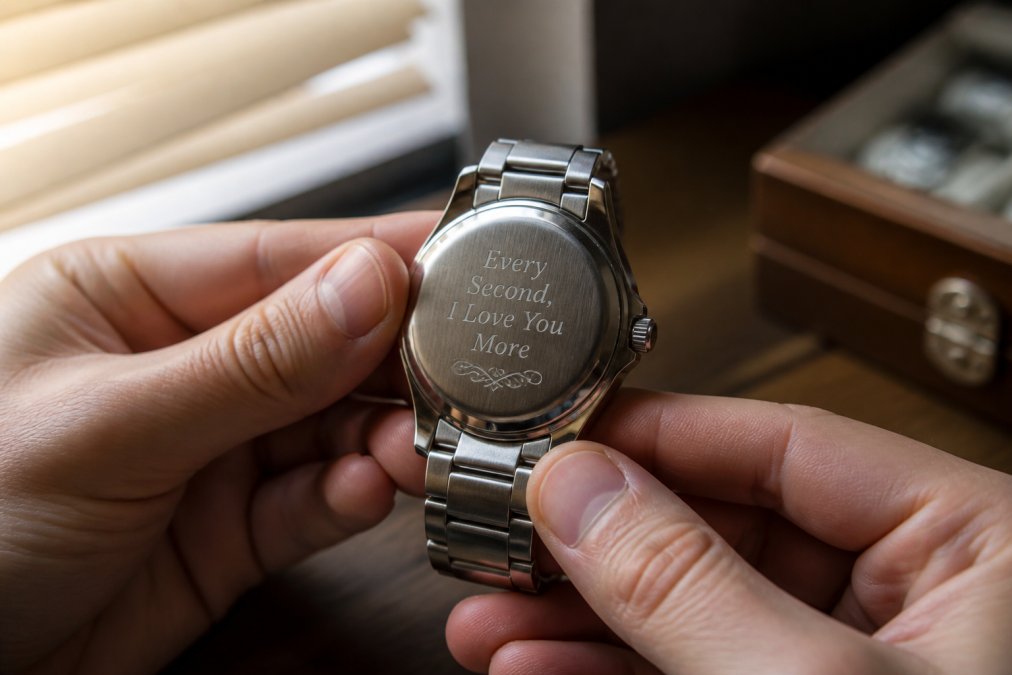
Metal hardness matters more than most people realize. Stainless steel resists scratching and holds engraved detail far better than softer metals like gold or silver. A deeper cut into harder steel means the lettering stays legible longer.
Does Watch Engraving Fade Over Time?
Yes, watch engraving can fade, but the timeline varies dramatically based on the engraving technique and the watch caseback location. A properly executed deep engraving on stainless steel can remain fully legible for decades, while a shallow laser mark on a soft metal might begin to blur within a few years of daily wear.
The fading process is gradual. The edges of the letters soften, the depth becomes shallower, and fine details like handwriting loops begin to merge together. Surface wear from resting the watch on desks, bumping it against door frames, and the constant friction of a shirt cuff all contribute to this slow erosion.
Laser vs. Mechanical Engraving Durability
Laser engraving and mechanical engraving produce different results when it comes to longevity. Mechanical engraving uses a rotating cutting tool to physically remove metal, creating a deeper cut that typically ranges from 0.2 to 0.5 millimeters (ganoksin.com). This depth provides excellent permanence because the lettering sits below the surface level where normal wear occurs.
Laser engraving, by contrast, vaporizes a thin layer of metal to create the mark. It offers exceptional precision for fine details like handwriting or intricate designs, but the resulting depth is often shallower than mechanical cutting. On hard stainless steel, a quality laser engraving still holds up well for years.
A common mistake is assuming all laser engraving is equal. The power settings, number of passes, and focus quality all affect depth. A skilled technician can produce a laser engraving that rivals mechanical depth, while a rushed job leaves a surface mark that fades quickly.
How Caseback Location Affects Wear
The caseback is the smartest location for engraving because it receives the least direct wear of any watch surface. The crystal faces outward, the bezel and case sides brush against cuffs and surfaces, but the caseback rests against your wrist, protected by skin and often a shirt cuff.
Engravings on the caseback still face challenges. Sweat and moisture create a corrosive environment against the metal over years of wear. The constant micro-movement of the watch against your wrist acts like fine sandpaper, slowly polishing the engraved surface. A caseback engraving on a watch worn daily will show more wear after five years than the same engraving on a watch worn only for special occasions.
How to Maintain Engraved Jewelry and Watches
Maintaining an engraved watch requires a different approach than cleaning the rest of the timepiece. The watch movement benefits from professional servicing every three to five years, but the engraving needs only gentle, regular care to preserve its depth and clarity (nist.gov). Environmental exposure is the primary driver of engraving degradation, and it acts differently on different metals.
The Environmental Toll: Salt Water, Sweat, and Friction
The three most destructive forces for an engraved caseback are salt water, sweat, and repetitive friction. Each attacks the metal in a distinct way.
Salt Water and Chlorine: Salt water is highly corrosive to most watch metals. For stainless steel, it can cause pitting and micro-corrosion along the sharp edges of an engraving, effectively blurring the crisp lines over time. Chlorine, found in pools and hot tubs, is even more aggressive. If you wear your engraved watch near the ocean or a pool, rinse it under lukewarm fresh water and dry it thoroughly before storing it.
Sweat and Skin Oils: The caseback rests directly against your skin, making it the primary collection point for sweat. Perspiration contains salts, urea, and lactic acid. Over years of daily wear, this acidic mixture slowly etches the metal surface. On a deep mechanical engraving in stainless steel, this effect is negligible for a decade or more. On a shallow laser engraving on a softer metal like gold, the acid can accelerate the smoothing of the lettering's edges.
Friction and Impact: Beyond the wrist, the caseback faces friction from desk surfaces, door frames, and the clasp of other bracelets. For those who type on a laptop for hours, the caseback can rub against the laptop deck, creating a polished, worn spot directly over the engraving.
Metal-Specific Maintenance Protocols
Stainless Steel (316L or 904L): This is the most forgiving metal for engraved watches. It resists corrosion well and holds its structure under friction. For daily care, wipe the caseback with a soft, dry microfiber cloth after each wear to remove sweat and oils before they accumulate. For deeper cleaning, use a mild soap and lukewarm water on a soft cloth, then dry thoroughly. Avoid abrasive cleaners and ultrasonic baths for the caseback area, as the vibration can loosen the seal over time.
Gold (14k or 18k): Gold is a much softer metal than stainless steel. An engraving in gold will naturally wear faster because the metal itself deforms more easily. The key to maintaining a gold engraving is to minimize friction. Do not wear a gold engraved watch while doing manual labor, typing for extended periods, or playing sports. Gold is also more susceptible to scratching from other jewelry, so store it in a separate compartment.
Titanium: Titanium is harder than stainless steel but has a unique property: it is prone to galling and can develop a grayish oxide layer over time. This oxide can fill in the fine details of a shallow engraving, making it appear faded even though the metal is intact. A soft brass brush or a specialized titanium cleaning cloth can remove this oxide layer, but you must be careful not to press hard enough to polish the engraving edges. Most watchmakers recommend a gentle soap-and-water wash for titanium casebacks rather than abrasive cloths.
Storage and Long-Term Protection
When storing the watch, keep it in a soft pouch or separate compartment away from other jewelry. Metal-on-metal contact in a drawer is a leading cause of surface scratches on casebacks. A watch box with individual slots or a microfiber pouch protects both the case and the engraving.
For those who live in humid climates or sweat heavily, consider using a watch winder or a dry storage box with a silica gel packet. Humidity accelerates corrosion on all metals, and a dry environment significantly slows the degradation of an engraving. If you are passing the watch down as an heirloom, store it in its original box with the papers, and note the engraving date.
Pros and Cons of Engraving Watch Case Backs
Engraving a watch caseback transforms a mass-produced timepiece into a one-of-a-kind sentimental keepsake, but the decision carries tradeoffs.
| Factor | Pros of Caseback Engraving | Cons of Caseback Engraving |
|---|---|---|
| Sentimental value | Creates a personal, irreplaceable keepsake | Message is hidden unless watch is removed |
| Resale value | Meaningful for family heirlooms | Reduces appeal to general buyers |
| Durability | Caseback is the most protected surface | Still faces sweat and daily friction |
| Customization | Adds handwriting, dates, or symbols | Cannot be removed without damaging the watch |
| Maintenance | Requires only gentle cleaning | Improper polishing can erase the engraving |
The primary advantage is emotional. A caseback engraving turns a watch into a specific memory: a graduation date, a child's name, an anniversary. The watch becomes more than a tool for telling time; it becomes a physical anchor for a moment you never want to forget.
The main drawback is permanence in the wrong direction. An engraving cannot be undone. If you later sell the watch or wish to regift it, the personal message remains. This matters most for buyers who view watches as investments rather than keepsakes.
Engraved Watches and Resale Value: What to Expect
Engraved watches typically carry lower resale value than identical unengraved models, a reality that surprises many first-time buyers. Collectors and secondhand buyers generally prefer clean, unmarked casebacks because they want a watch that feels new, not one tied to someone else's memory.
The depreciation varies by brand and market. For mass-market watches, an engraving can reduce the resale price noticeably because the pool of interested buyers shrinks. For luxury pieces, collectors may view engraving as damage and discount the watch significantly, though some rare vintage pieces with historical engravings can command premiums.
This tradeoff matters only if you plan to sell. A watch purchased as a graduation gift or anniversary present is rarely sold by the recipient. The engraving transforms the watch into an heirloom, meant to be passed down rather than traded. According to guidelines on caring for personal jewelry keepsakes, the emotional value of personalized items often outweighs their market value for the recipient.
Restoring and Caring for Faded Engravings
A faded engraving is not always lost, but restoration options depend on how much metal has worn away and what metal the caseback is made from. Most owners assume a faded engraving is gone forever, but a skilled watchmaker can often bring it back to legibility, provided you act before the lettering disappears entirely.
When Restoration Is Possible: The 50% Rule
A common pattern among watchmakers is the "50% rule": if at least half of the original engraving depth remains, it can usually be restored. If less than half remains, the risk of cutting through the caseback or creating an uneven surface becomes too high. The key variable is the original depth. A mechanical engraving cut to 0.4 millimeters can lose half its depth and still have 0.2 millimeters left to work with. A shallow laser engraving that started at 0.1 millimeters has almost no margin for error.
Restoration Methods by Metal
Stainless Steel: This is the most straightforward metal to restore. A watchmaker can use a rotary engraving tool with a diamond-tipped cutter to re-cut the existing lettering, following the original grooves. The challenge is matching the original font and depth precisely. Most practitioners find that re-cutting to a depth of 0.3 to 0.4 millimeters provides a good balance between legibility and structural integrity. The watch retains its water resistance as long as the caseback is not thinned excessively.
Gold: Restoring an engraving on gold is riskier because the metal is soft and the original engraving is likely shallower. Re-cutting a gold caseback requires a gentler touch and a lower spindle speed to avoid tearing the metal. The watchmaker may also need to use a laser engraver instead of a mechanical cutter, because the laser can add depth without putting physical stress on the soft metal. However, laser re-engraving on gold produces a slightly different finish than the original mechanical cut, which can be visible under close inspection.
Titanium: Titanium presents a unique challenge because it work-hardens as it is cut. A mechanical re-cut on titanium can cause the metal to become brittle at the edges of the lettering. Most watchmakers prefer to use a laser for titanium restoration, as it vaporizes the metal cleanly without the work-hardening effect. The downside is that laser re-engraving on titanium may produce a lighter-colored mark that contrasts with the darker oxidized surface of an older caseback.
The Refinishing Problem
For engravings worn completely smooth, restoration becomes more complex. The watchmaker may need to refinish the entire caseback surface before re-engraving, which changes the watch's appearance and can affect its water resistance. Refinishing involves removing a thin layer of metal from the entire caseback to create a uniform surface. On a stainless steel watch, this might mean removing 0.1 to 0.2 millimeters of material. On a gold watch, that same removal could significantly thin the caseback and compromise the gasket seal.
This is why early intervention matters. Catching a fading engraving while the lettering is still legible gives the watchmaker the best chance of restoring it without a full refinish. If you notice that the edges of the letters are no longer sharp to the touch, or that the engraving is becoming difficult to read under normal lighting, schedule a consultation with a watchmaker who has engraving experience.
The Cost Reality and When to Skip It
Restoration is not inexpensive. A simple re-cut of an existing engraving on a stainless steel caseback depends on the complexity of the lettering and the shop's hourly rate. A full refinish plus re-engraving can be more. For a watch with significant sentimental value, this cost is often justified.
Preventing the Need for Restoration
The best restoration is the one you never need. Beyond the cleaning and storage routines covered earlier, the single most effective way to preserve an engraving is to rotate your watches. If you wear the same engraved watch every day for a decade, the caseback will show significantly more wear than if you alternate it with another piece. For those who want a single daily wearer, choose a stainless steel caseback with a deep mechanical engraving.
The Bottom Line: How Long Will Your Engraved Watch Last?
An engraved watch can last a lifetime, but the engraving and the movement age on different schedules. The watch mechanism, with proper servicing every few years, can run for decades and become a treasured family heirloom. The engraving, protected on the caseback and cared for with gentle cleaning, can remain legible just as long.
The key variables are metal hardness, engraving depth, and wear patterns. Stainless steel with a deep mechanical or high-quality laser engraving offers the best combination of permanence and legibility. Softer metals and shallow cuts fade faster, especially with daily wear.
For those seeking a lasting engraved watch, Flogaze offers personalized timepieces crafted from high-quality stainless steel designed to withstand constant use while preserving the sentiment of your message. Our water-resistant and scratch-proof designs arrive in a gift box, ready to present for graduations, anniversaries, and family milestones. Get started with Flogaze and give a gift that carries your words for years to come.
Frequently Asked Questions
Is it a good idea to engrave a watch?
Yes, if you value the sentimental connection over potential resale value. An engraved watch becomes a unique keepsake that marks a specific moment, making it a meaningful gift for graduations, anniversaries, or milestone birthdays. The engraving itself does not affect the watch's mechanical function or water resistance when done correctly on the caseback. Just be aware that personalization typically reduces the financial resale value, since the message limits its appeal to future buyers.
What is the best metal for watch engraving?
Stainless steel is the most practical choice for engraved watches. It is hard enough to hold crisp lettering for decades yet not so hard that it resists the engraving process. The depth of cut remains legible through daily wear, and stainless steel resists corrosion that could blur the design. Titanium is also a good option, though its darker color makes engravings less visible. Avoid softer metals like gold or plated brass for daily-wear pieces, as they show surface wear more quickly.
How expensive is it to engrave a watch?
Engraving costs depend on the method, the jewelry store, and the complexity of your message. Laser engraving is often an affordable option, while hand engraving by a skilled artisan costs more due to the time involved. Machine engraving falls in between. Many retailers include complimentary engraving with the purchase of a personalized watch. For exact pricing, check with the specific jeweler or the brand's website.
Can a watch last 100 years?
A quality mechanical watch can last 100 years or more if it receives regular service, typically every five to seven years, to maintain the movement. The case and caseback can also survive that long with proper care. The engraving itself will likely last just as long, especially on a stainless steel caseback. It may lose some crispness after decades of wear, but the message remains legible. The limiting factor is usually the movement's parts, not the metal or the engraving.


